A webhook is an event-driven method for one system to notify another system when something important happens. Instead of waiting for a second application to repeatedly ask whether data has changed, the source application sends an HTTP request to a predefined URL as soon as the event occurs. In practical terms, a webhook acts like an automatic callback between systems. It turns a business event, platform event, or workflow event into an immediate machine-to-machine notification that another application can receive and process.
This simple model has become one of the most widely used integration patterns in modern software. Payment platforms use webhooks to report successful charges, failed transactions, and refunds. Code hosting platforms use them to notify deployment tools about pushes, pull requests, or issue changes. Messaging services use them to forward inbound message events. SaaS products use them to synchronize accounts, tickets, orders, subscriptions, alerts, and automation flows. Because the mechanism is lightweight and fast, webhooks are often one of the first tools teams use when they want different systems to react to each other in real time.
Understanding Webhooks
What a Webhook Means
A webhook is usually a user-configured HTTP endpoint that receives event notifications from another platform. The sending platform is told which URL to call and which events should trigger a delivery. When a selected event occurs, the platform packages event data into a request and sends it to the target endpoint. The receiving application then validates the request, interprets the payload, and decides what action to take next.
For that reason, a webhook is often described as an event callback, an event notification endpoint, or a push-based integration mechanism. Unlike a general-purpose API, which is designed for clients to request data whenever they want it, a webhook is designed for the platform to push data outward when an event actually happens. That difference is what gives webhooks much of their operational value.
Why Webhooks Became So Common
Webhooks became popular because many business systems do not work well when every connected application has to keep polling for updates. Repeated polling increases unnecessary requests, consumes API limits, adds latency between the moment an event happens and the moment another system notices it, and creates extra processing load on both sides. Webhooks solve that problem by making the event source responsible for notification.
This push model is especially useful in distributed systems where timing matters. When a payment succeeds, an order system may need to release fulfillment immediately. When a customer submits a form, a CRM may need to create a lead at once. When a repository is updated, a CI/CD pipeline may need to start automatically. In all of these cases, the webhook model reduces waiting time and helps different systems behave as parts of one continuous business process.
That is why webhooks are frequently used even in architectures that still rely on APIs for other purposes. An API may be used to query or modify resources, while a webhook is used to notify connected systems that a change has already occurred. Together they form a practical request-and-event integration pattern.
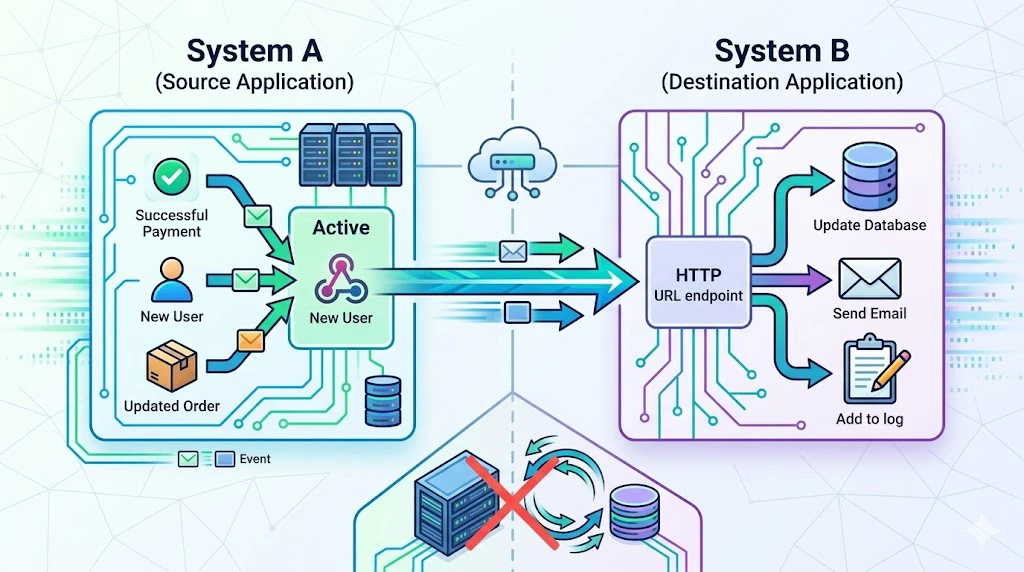
Webhook integrations allow one application to notify another system immediately when a selected event occurs.
How a Webhook Works
Event Trigger, Callback URL, and Delivery
The basic webhook flow begins with an event source. This may be a payment service, a cloud platform, a messaging service, a code repository, an ERP system, or another application capable of sending notifications. An administrator or developer configures a callback URL on the receiving side, and the sending platform stores that destination as the endpoint for event deliveries.
When a subscribed event occurs, the platform creates a webhook delivery and sends it to the configured endpoint. In many implementations, the request is an HTTP POST containing structured data such as JSON, form parameters, or platform-specific fields. The request usually includes headers, metadata, event identifiers, timestamps, and signatures or verification fields to help the receiving system validate the sender and interpret the payload correctly.
Once the request reaches the receiving service, the application checks whether the request is authentic, parses the event data, records the delivery, and runs business logic. That may include updating a database, creating a ticket, initiating a workflow, sending a notification, modifying an order state, or passing the event to a message queue for additional processing.
Payloads, Headers, and Event Handling
Although webhook designs vary by platform, many follow a similar structure. The payload contains information about the event itself, such as what happened, when it happened, and which resource was affected. The request headers may identify the event type, provide a delivery identifier, and include a signature for verification. The receiving endpoint reads these fields and maps them to the logic required by the business or application workflow.
In a robust implementation, event handling is separated into stages. The endpoint receives the event, performs authentication and basic validation, stores or acknowledges the event quickly, and then processes it safely in the background or through a controlled workflow engine. This pattern helps reduce delivery failures and prevents slow processing from causing unnecessary timeouts or duplicate retries.
A webhook is powerful because it converts change into action. The moment a system knows something important happened, it can immediately tell another system instead of waiting to be asked.
Core Functions of Webhooks
Real-Time Event Notification
The most fundamental function of a webhook is real-time or near-real-time event notification. It allows platforms to communicate change as it happens instead of relying on scheduled checks. This makes integrations more responsive and helps business systems react faster to customer activity, platform state changes, or operational signals.
In many environments, this function is the difference between delayed coordination and continuous automation. A webhook can notify a shipping system when payment clears, alert a monitoring platform when an incident opens, tell a CRM when a lead changes status, or inform a collaboration tool that a new record needs human attention. The receiving application does not need to discover the event later because the source system reports it directly.
Workflow Automation Between Systems
Webhooks are also a practical automation bridge. They do not merely announce events; they can initiate follow-up actions across applications. A webhook from an e-commerce platform can start order routing. A webhook from a ticketing platform can create a support workflow. A webhook from a deployment system can trigger testing, notifications, or infrastructure changes. This ability makes webhooks central to many low-code, no-code, and enterprise integration platforms.
Because webhook events are typically tied to specific actions and states, they fit naturally into workflow engines. Instead of building constant synchronization jobs, teams can design event-driven steps that react only when something meaningful occurs. This makes automation more efficient and easier to align with real business processes.
System Synchronization and Status Updates
Another important function is cross-system synchronization. Many organizations use multiple SaaS platforms, internal databases, messaging tools, analytics systems, and service applications at the same time. When one of those systems changes a record, updates a status, or completes a transaction, other systems may need to know immediately. Webhooks allow those updates to propagate without long polling intervals or repeated manual exports.
This is especially useful for subscription billing, user lifecycle management, incident response, customer support, logistics, and DevOps. A system does not need to constantly compare two data sets to see whether a change happened. Instead, the event becomes the synchronization trigger, and the receiving platform decides how to update its own records or workflows in response.
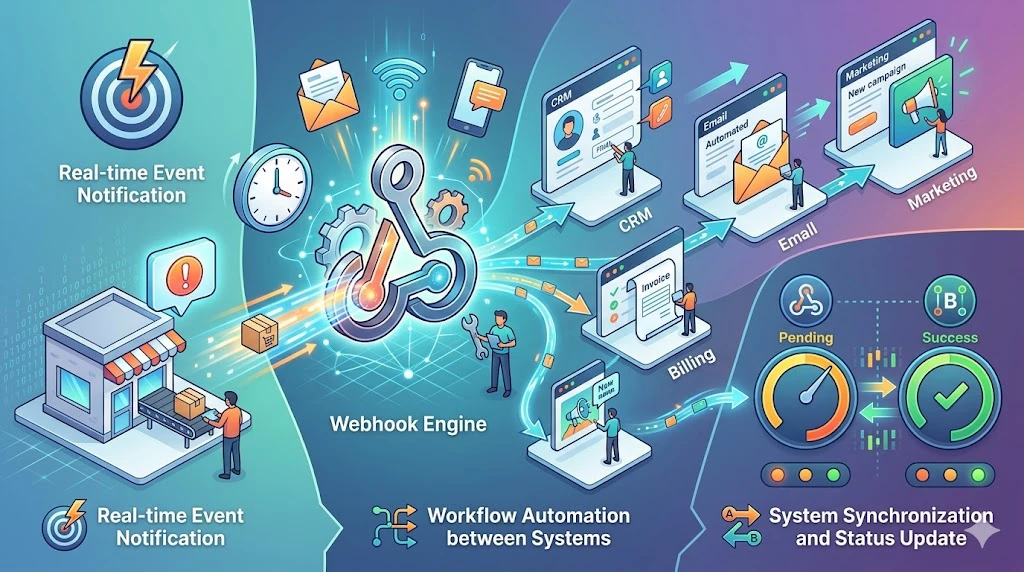
Webhooks are commonly used to support event notification, automation, and system synchronization across connected applications.
System Value of Webhooks
Lower Polling Overhead and Better Efficiency
One of the biggest system-level benefits of webhooks is efficiency. In a polling model, connected systems may need to send repeated requests to ask whether anything has changed. Even when nothing has happened, those requests still consume bandwidth, compute time, API quotas, and processing resources. Webhooks reduce that overhead because messages are sent only when relevant events occur.
This can improve scalability in environments where many systems interact frequently. Instead of thousands of periodic checks across multiple integrations, the architecture shifts toward event-triggered communication. That often reduces noise, lowers wasted requests, and makes better use of infrastructure resources. The benefit becomes even more visible when the event frequency is lower than the polling frequency that would otherwise be needed to achieve similar responsiveness.
Faster Reaction and Better User Experience
Webhooks also improve reaction time. If a business process depends on knowing about a change quickly, waiting for the next polling cycle can create delays. A customer may have paid, but fulfillment has not started yet. A ticket may have escalated, but alerting has not updated yet. A deployment may have failed, but the incident channel has not been notified yet. Webhooks shorten that gap by delivering events as soon as the source platform issues them.
That faster reaction can improve the user experience in many ways. Users may receive confirmations sooner, support workflows may advance more quickly, internal teams may see more timely status changes, and system dashboards may reflect reality with less delay. In customer-facing systems, this can make the difference between a workflow that feels automatic and one that feels slow or disconnected.
Stronger Integration Design in Event-Driven Systems
Beyond efficiency and speed, webhooks reinforce an event-driven architectural model. Instead of treating every integration as a sequence of manual checks and scheduled tasks, organizations can design systems around business events such as order created, invoice paid, ticket closed, device alarm raised, or repository updated. This makes integration logic more modular because each event can be mapped to the systems that care about it.
That architecture is valuable even when the webhook itself is simple. The event can become the trigger for queues, serverless functions, workflow engines, internal APIs, logging systems, and analytics pipelines. In other words, the webhook may only be the first step, but it often becomes the gateway through which the rest of the automation begins.
The real system value of a webhook is not just that it sends data. It allows distributed applications to behave like a coordinated process by reacting to events with much less delay and much less waste.
Security, Reliability, and Operational Considerations
Signature Verification and Endpoint Security
Because webhooks deliver data automatically from one system to another, security is essential. A receiving service should not trust every incoming request that claims to be an event notification. Most serious webhook implementations therefore use verification methods such as shared secrets, request signatures, HTTPS transport, or platform-specific validation rules. These mechanisms help confirm that the request really came from the expected provider and that the payload was not altered in transit.
Endpoint security also matters at the operational level. The receiving URL should be carefully exposed, monitored, and documented. Teams should control access, protect secrets, log deliveries, and avoid writing webhook handlers that perform risky actions before a request is validated. In mature environments, webhook endpoints are treated as production integration interfaces rather than as disposable callback scripts.
Retries, Idempotency, and Failure Handling
Reliable webhook design also depends on failure handling. Networks fail, services time out, dependencies become unavailable, and receivers sometimes return errors. For that reason, many webhook providers support retry behavior or redelivery workflows when an endpoint does not acknowledge a request successfully. On the receiving side, applications often need idempotent processing logic so the same event can be handled safely more than once without creating duplicate business actions.
This is especially important in payments, messaging, order management, and infrastructure automation. If a payment success event arrives twice, the receiver should not ship the same order twice. If a ticketing event is replayed, the receiver should not create duplicate records. Good webhook consumers therefore store event identifiers, track processing state, and separate acknowledgment from downstream side effects whenever possible.
Observability is another part of reliability. Teams should log incoming deliveries, record response status, maintain replay procedures where available, and provide internal monitoring around webhook failures. A webhook is only useful when the event reaches the destination and is processed correctly.
Versioning and Change Control
As platforms evolve, webhook payload formats, event schemas, and delivery behavior may also change. Mature systems therefore treat webhooks as versioned interfaces. They document the payload structure they expect, validate required fields, and manage upgrades carefully when providers introduce new event formats or API versions.
This matters because webhooks are often embedded deeply into business automation. A poorly managed schema change can break downstream workflows silently if the receiver assumes an old payload format. Clear change control, defensive parsing, and contract-aware integration design help reduce that risk.
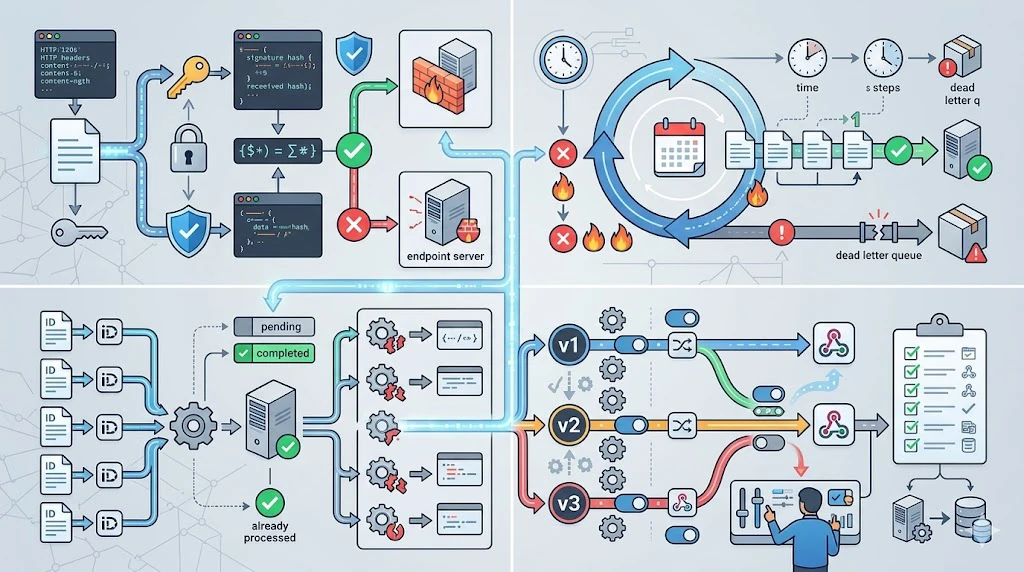
Secure and reliable webhook design usually includes signature verification, delivery logging, retry awareness, and idempotent event handling.
Common Applications of Webhooks
SaaS Platforms and Business Automation
One of the most common application areas for webhooks is SaaS integration. CRM platforms, help desk tools, e-commerce systems, billing services, marketing systems, and collaboration platforms all generate business events that other systems may need to consume. Webhooks allow those systems to notify internal applications, workflow engines, automation platforms, or partner services when records change or actions occur.
In this setting, webhooks are often used to connect cloud tools without requiring heavy custom integration layers. A lead creation event can trigger a marketing workflow. A contract signature event can update a CRM. A subscription change event can synchronize billing and access control. This makes webhooks especially useful in organizations that depend on many specialized applications working together.
Payments, Commerce, and Subscription Systems
Payments are one of the clearest use cases for webhooks because many important events happen asynchronously. A payment may succeed after customer authentication, a refund may be issued later, a dispute may be opened, or a subscription invoice may fail after the initial checkout flow. Webhooks allow payment platforms to report those events back to merchant systems so order status, fulfillment, accounting, and customer notifications can stay aligned with real transaction outcomes.
E-commerce and subscription businesses rely heavily on this model because it supports continuous status synchronization. Instead of assuming that the state visible during the initial payment request is final, the merchant uses webhook events to manage the true lifecycle of the transaction. This reduces business errors and helps downstream systems respond correctly to later changes.
DevOps, Source Control, and CI/CD
Webhooks are also deeply embedded in developer tooling. Source control platforms can send webhook events when code is pushed, pull requests are opened, issues are updated, or repository settings change. CI/CD systems and deployment tools listen for those events and react automatically by running tests, building artifacts, updating preview environments, or sending status messages to collaboration channels.
This application area shows how webhooks support operational speed. Developers do not need to press a button each time a repository change should trigger a pipeline. The event itself becomes the trigger, and the rest of the workflow starts automatically. That is one reason webhooks are treated as a foundational pattern in modern software delivery.
Messaging, Alerts, and Operational Notifications
Messaging services, telephony platforms, and alerting systems use webhooks to report inbound messages, call events, delivery receipts, status changes, and incidents. A webhook can pass a message event into a CRM, send a call status update into a ticketing system, or route monitoring alerts into an incident response workflow. The receiving application can then take action based on business context instead of just raw event data.
This is particularly useful in operational environments where different channels must be coordinated quickly. A webhook may be the bridge between a monitoring platform and an on-call system, between a messaging service and a support desk, or between a device management platform and a notification engine. In all of these cases, the webhook acts as the event entry point for a larger response process.
Wherever different platforms need to react to the same business moment, webhooks provide one of the simplest and most practical ways to connect them.
Webhook Compared with APIs and Polling
Webhook vs. API Request Model
A webhook is not a replacement for an API. The two serve different purposes. An API allows a client to request, create, update, or delete resources on demand. A webhook allows a platform to notify another system that an event has happened. In many integrations, the webhook provides the signal and the API provides the detailed follow-up action.
For example, a webhook may notify a receiver that an order was updated, while the receiver then calls an API to retrieve full order details or execute another action. This means webhooks and APIs are often complementary rather than competing approaches. The webhook carries urgency and event awareness, while the API carries control and direct resource interaction.
Webhook vs. Polling
The webhook model is also different from polling. Polling requires the receiving application to ask the source system repeatedly whether anything has changed. Webhooks reverse that responsibility. The source system sends the notification when the event occurs. This usually reduces request volume and improves timeliness, especially for asynchronous or irregular events.
Polling still has a role in some situations, such as fallback monitoring, periodic reconciliation, or environments where outbound webhook delivery is not possible. But in most event-driven integrations, webhooks offer a more efficient and more responsive mechanism for change notification.
Conclusion
Why Webhooks Matter
A webhook is a practical event-driven integration mechanism that allows one application to notify another application automatically when something happens. Its core functions include event notification, workflow triggering, and cross-system synchronization. Its system value comes from reducing polling overhead, improving reaction time, and supporting cleaner event-driven architecture across modern software environments.
That is why webhooks appear in so many platforms today. They are widely used in SaaS automation, payment processing, DevOps pipelines, messaging systems, alerting workflows, and enterprise integrations. Although the concept is simple, the operational impact can be significant when webhooks are designed with proper security, logging, retry handling, and business logic. In many real-world systems, the webhook is the moment where one platform’s event becomes another platform’s action.
FAQ
Is a webhook the same as an API?
No. A webhook and an API are related but not the same. An API is generally used when a client wants to request or manipulate resources on demand. A webhook is generally used when a platform wants to notify another system that an event has happened. One is request-driven, while the other is event-driven.
In many integrations they work together. A webhook can announce that something changed, and an API can then be used to fetch full details or perform follow-up actions.
Does a webhook always use HTTP POST?
Many webhook systems use HTTP POST, especially when structured payloads such as JSON need to be delivered in the request body. However, implementation details vary by provider, and some platforms also support other request styles or platform-specific patterns.
The main idea is not the exact verb. The key idea is that the sending platform makes an outbound HTTP request to a configured endpoint when an event occurs.
Why is webhook security important?
Webhook security matters because the receiving endpoint can trigger real business actions such as updating records, releasing orders, sending notifications, or launching workflows. If the receiver accepts unauthenticated requests, an attacker could potentially send fake events and cause incorrect processing.
That is why serious webhook designs use HTTPS, signature verification, secret handling, delivery logging, and careful request validation before business logic is executed.
What is the main advantage of a webhook?
The main advantage is timely event-driven communication. A webhook lets one system notify another as soon as an event occurs, which reduces the need for repeated polling and allows faster automation, synchronization, and response.
This can improve both technical efficiency and business responsiveness, especially in environments where multiple platforms need to stay aligned with changing states in near real time.