touchpoint

In addition to terminal devices, all personnel, places, and things connected to the network should also be considered.

View Details

resource

Understand best practices, explore innovative solutions, and establish connections with other partners throughout the Baker community.

×

touchpoint

touchpoint

In addition to terminal devices, all personnel, places, and things connected to the network should also be considered.

Learn more

resource

resource

Understand best practices, explore innovative solutions, and establish connections with other partners throughout the Baker community.

Contact Us
Introduction to the Multicast Function and How to Use It

Introduction

Overview

The multicast function allows the sender to transmit voice information and other audio content to a configured multicast address. All phones that are listening to that multicast address can receive the transmitted audio. This function works similarly to a paging or broadcast system. With multicast, announcements can be delivered easily and efficiently to every member in the multicast group.
Operating mechanism:

  • The phone uses a DSS key to configure the multicast sending address, port, and codec.
  • The multicast listening address and port are configured through the web interface or LCD menu.
  • When a phone starts a multicast session, all phones listening to that address can receive the multicast audio.

Multicast Configuration and Usage

Multicast Sender Configuration

Open the phone web interface and click “Function Key” - “Function Key Settings”. Set one function key type to MCAST Paging, and set the value in the format IP:Port.
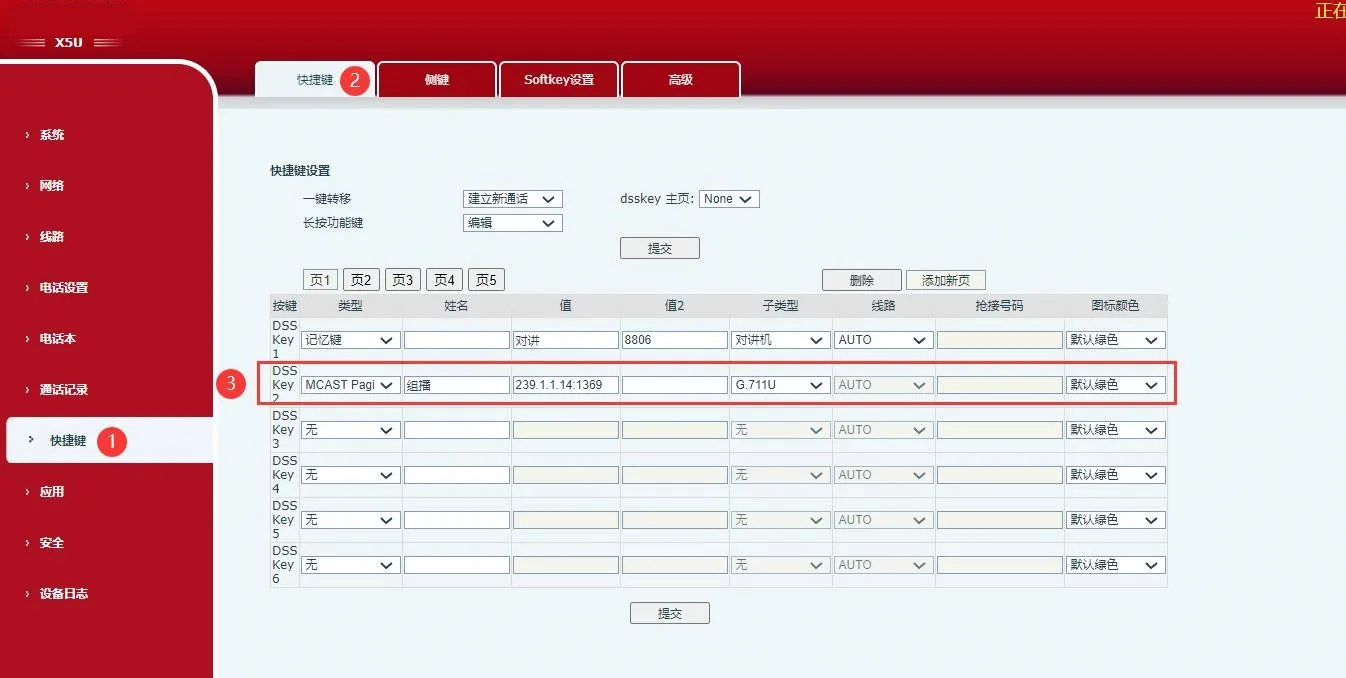
Multicast sender configuration
Usage notes: Configure a function key and set its type to MCAST Paging, then define the multicast address and port. In standby mode, press the corresponding function key to start multicast paging.

Multicast Listener Configuration

There are two ways to listen to multicast audio: automatic listening and manual listening.
2.2.1 Automatic Multicast Listening Configuration
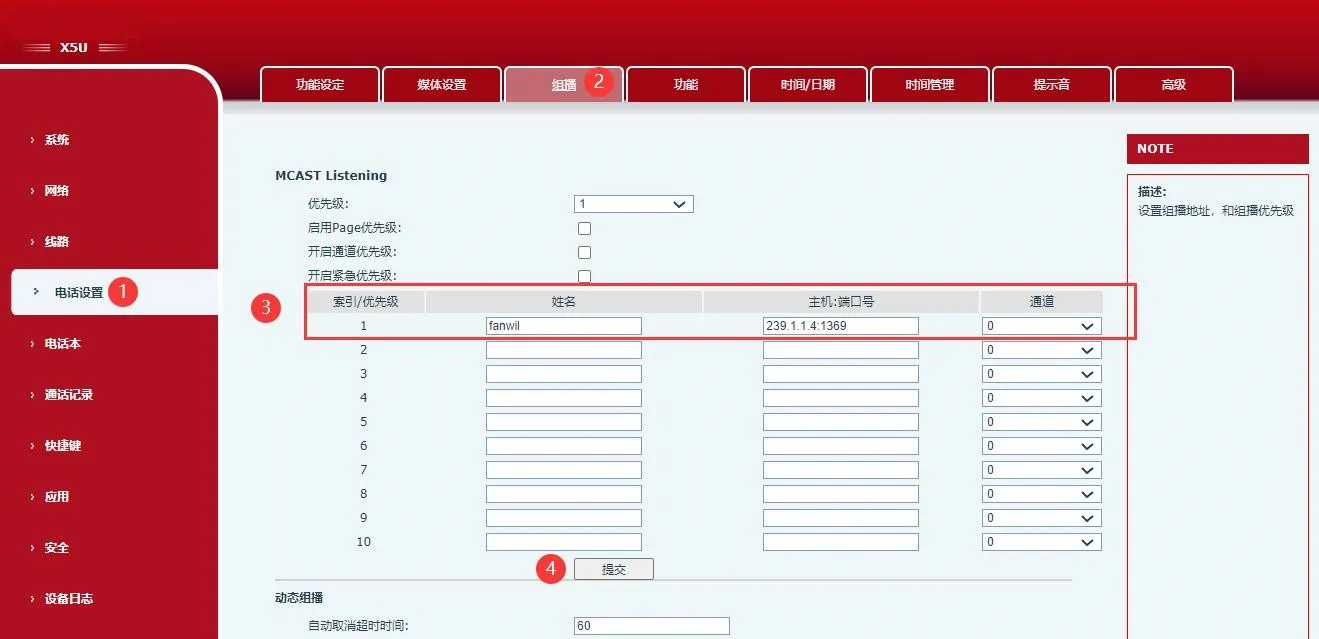
Open the phone web interface and click “Phone Settings” - “Multicast”, then configure parameters such as the multicast name and multicast address.

Parameter Description
Priority Sets the priority of normal calls, meaning non-multicast calls. The smaller the number, the higher the priority.
For example, if the phone is already in one or more normal non-multicast calls: when the priority is set to Disable, multicast calls of any level will not be answered and will be rejected;
when the priority is set to a specific value, only multicast calls with a higher priority than that value can be answered, and other calls will be placed on hold at the same time.
Enable Page Priority Determines whether priority comparison between multicast pages is enabled. The multicast priority is the index/priority shown on the left side of the multicast list.
Enable Channel Priority Channel 24 is the priority channel. This takes effect only after channel priority is enabled.
Enable Emergency Priority Channel 25 is the emergency channel. This takes effect only after emergency priority is enabled.
Index / Priority The numeric value represents the multicast priority. It takes effect after page priority is enabled. The smaller the number, the higher the priority.
Name Sets the name of the multicast being monitored. This name will be displayed on the screen when the multicast is answered. If it is not configured, the screen will display the IP:Port directly.
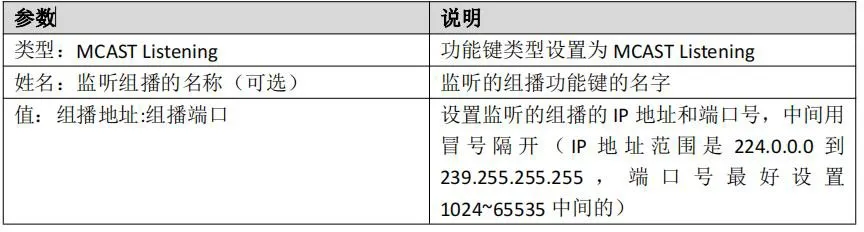
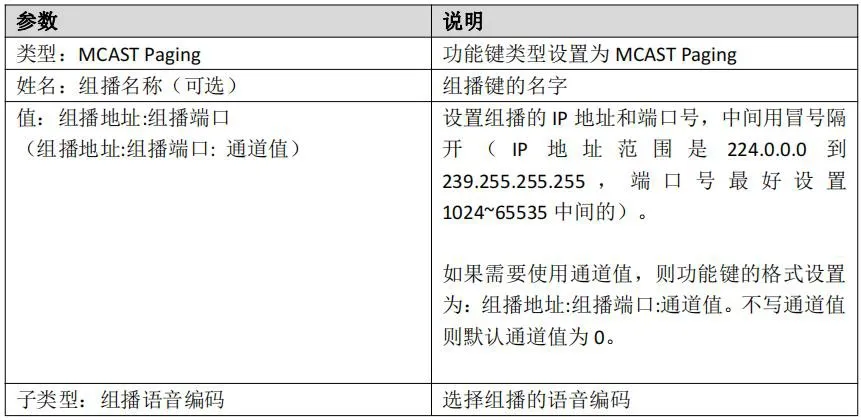
Host:Port Sets the IP address and port number of the multicast to be monitored, separated by a colon. The IP address range is from 224.0.0.0 to 239.255.255.255, and the recommended port range is 1024 to 65535.
Channel When the channel value is 0, the multicast sends RTP packets; when the channel value is 1-25, it sends paging protocol packets; when the channel value is invalid, it falls back to the default RTP protocol. The default value is 0.

Automatic multicast listening configuration
Usage notes: After configuring the multicast listening address, port, and multicast priority, the phone will automatically answer and display the call screen when a multicast session is started on the monitored address.

2.2.2 Manual Multicast Listening

Open the phone web interface and click “Function Key” - “Function Key Settings”. Set one function key type to MCAST Listening, and set the value in the format IP:Port.
Manual multicast listening

Usage Instructions

① Configuration: On the function key page, configure a multicast listening function key, then save the multicast address and port settings.
② Operation: In standby mode, press the configured function key.
③ Result: If RTP is present on the configured multicast address, the phone will connect and play the multicast audio, display the multicast screen, and the function key indicator will turn red. If RTP is not present on the configured multicast address, the phone will play a prompt tone after the key is pressed, indicating that the operation is unavailable.
④ Operation: Press the same function key again.
⑤ Result: The phone stops the multicast session, exits the multicast screen, and returns to standby mode.

catalogue
Professional industrial communication manufacturer, providing high reliability communication guarantee!
Cooperation Consultation
customer service Phone
We use cookie to improve your online experience. By continuing to browse this website, you agree to our use of cookie.

Cookies

This Cookie Policy explains how we use cookies and similar technologies when you access or use our website and related services. Please read this Policy together with our Terms and Conditions and Privacy Policy so that you understand how we collect, use, and protect information.

By continuing to access or use our Services, you acknowledge that cookies and similar technologies may be used as described in this Policy, subject to applicable law and your available choices.

Updates to This Cookie Policy

We may revise this Cookie Policy from time to time to reflect changes in legal requirements, technology, or our business practices. When we make updates, the revised version will be posted on this page and will become effective from the date of publication unless otherwise required by law.

Where required, we will provide additional notice or request your consent before applying material changes that affect your rights or choices.

What Are Cookies?

Cookies are small text files placed on your device when you visit a website or interact with certain online content. They help websites recognize your browser or device, remember your preferences, support essential functionality, and improve the overall user experience.

In this Cookie Policy, the term “cookies” also includes similar technologies such as pixels, tags, web beacons, and other tracking tools that perform comparable functions.

Why We Use Cookies

We use cookies to help our website function properly, remember user preferences, enhance website performance, understand how visitors interact with our pages, and support security, analytics, and marketing activities where permitted by law.

We use cookies to keep our website functional, secure, efficient, and more relevant to your browsing experience.

Categories of Cookies We Use

Strictly Necessary Cookies

These cookies are essential for the operation of the website and cannot be disabled in our systems where they are required to provide the service you request. They are typically set in response to actions such as setting privacy preferences, signing in, or submitting forms.

Without these cookies, certain parts of the website may not function correctly.

Functional Cookies

Functional cookies enable enhanced features and personalization, such as remembering your preferences, language settings, or previously selected options. These cookies may be set by us or by third-party providers whose services are integrated into our website.

If you disable these cookies, some services or features may not work as intended.

Performance and Analytics Cookies

These cookies help us understand how visitors use our website by collecting information such as traffic sources, page visits, navigation behavior, and general interaction patterns. In many cases, this information is aggregated and does not directly identify individual users.

We use this information to improve website performance, usability, and content relevance.

Targeting and Advertising Cookies

These cookies may be placed by our advertising or marketing partners to help deliver more relevant ads and measure the effectiveness of campaigns. They may use information about your browsing activity across different websites and services to build a profile of your interests.

These cookies generally do not store directly identifying personal information, but they may identify your browser or device.

First-Party and Third-Party Cookies

Some cookies are set directly by our website and are referred to as first-party cookies. Other cookies are set by third-party services, such as analytics providers, embedded content providers, or advertising partners, and are referred to as third-party cookies.

Third-party providers may use their own cookies in accordance with their own privacy and cookie policies.

Information Collected Through Cookies

Depending on the type of cookie used, the information collected may include browser type, device type, IP address, referring website, pages viewed, time spent on pages, clickstream behavior, and general usage patterns.

This information helps us maintain the website, improve performance, enhance security, and provide a better user experience.

Your Cookie Choices

You can control or disable cookies through your browser settings and, where available, through our cookie consent or preference management tools. Depending on your location, you may also have the right to accept or reject certain categories of cookies, especially those used for analytics, personalization, or advertising purposes.

Please note that blocking or deleting certain cookies may affect the availability, functionality, or performance of some parts of the website.

Restricting cookies may limit certain features and reduce the quality of your experience on the website.

Cookies in Mobile Applications

Where our mobile applications use cookie-like technologies, they are generally limited to those required for core functionality, security, and service delivery. Disabling these essential technologies may affect the normal operation of the application.

We do not use essential mobile application cookies to store unnecessary personal information.

How to Manage Cookies

Most web browsers allow you to manage cookies through browser settings. You can usually choose to block, delete, or receive alerts before cookies are stored. Because browser controls vary, please refer to your browser provider’s support documentation for details on how to manage cookie settings.

Contact Us

If you have any questions about this Cookie Policy or our use of cookies and similar technologies, please contact us at support@becke.cc .