Cloud services are computing resources and digital capabilities delivered over a network, most commonly the internet, on an on-demand basis. Instead of buying, installing, and maintaining every server, storage array, software platform, or application inside their own facilities, organizations can use cloud-based resources provided by a service operator and access them when needed. These services may include computing power, data storage, databases, networking, analytics, development platforms, security tools, collaboration software, backup systems, and many other business functions.
In practical terms, cloud services change how organizations acquire and use technology. Traditional IT models often require large upfront investment, hardware planning, long procurement cycles, and ongoing maintenance work. Cloud services introduce a more flexible operating model in which capacity, platforms, and applications can be provisioned faster, expanded more easily, and aligned more closely with actual business demand. This is one of the reasons cloud services have become central to digital transformation, modern software delivery, remote collaboration, and multi-site business operations.
Cloud services are important not only because they move workloads off local hardware, but because they change the relationship between technology and business value. They help organizations shift from static infrastructure ownership toward service-based consumption. That shift supports greater agility, faster deployment, more elastic resource use, and a broader range of technology choices across enterprise, public sector, industrial, education, healthcare, and communications environments.

Cloud services deliver computing, storage, software, and business capabilities through flexible online service models.
What Cloud Services Mean in Modern IT
A Service-Based Delivery Model for Technology
At the most basic level, cloud services mean that technology resources are provided as services rather than managed entirely as local physical assets. A business does not need to own every part of the underlying infrastructure in order to use computing power, run applications, store data, or support users. Instead, the organization consumes these capabilities through a provider-managed environment and accesses them through networks, management portals, APIs, or web interfaces.
This service-based model changes both operations and planning. IT teams can focus more on service design, workload performance, security policy, integration, and user experience rather than spending all of their time on hardware lifecycle tasks. It also allows business units to adopt new technology capabilities more quickly when market conditions, service needs, or growth demands change.
That is why cloud services are not limited to one specific product category. They represent a broader operational approach to computing in which resources are abstracted, standardized, and delivered as usable services.
More Than Remote Storage or Hosted Software
Many people first encounter cloud services through file storage, email, or collaboration software, but cloud services extend far beyond those examples. They include infrastructure for running virtual machines, platforms for building applications, managed databases, identity services, AI and analytics tools, cybersecurity services, development environments, media delivery, communications platforms, and industrial data processing systems.
Because of this wide scope, cloud services are often part of both business IT and operational technology strategy. A company may use cloud services to host websites, run ERP systems, support remote users, analyze field data, manage backups, operate customer applications, or centralize multi-site communications. The cloud is therefore not a single function. It is a broad service ecosystem that supports many different technical and business outcomes.
Cloud services are best understood as a delivery model for technology capabilities, not just as a place where files or applications happen to be stored.
How Cloud Services Work
Shared Infrastructure, Virtualization, and Service Abstraction
Cloud services typically rely on large-scale data center infrastructure operated by a provider. Inside that environment, physical servers, storage systems, and networks are abstracted into logical resources that can be provisioned for customers as needed. Virtualization, orchestration, automation, and software-defined management play a major role in making this possible.
Instead of interacting directly with every underlying hardware component, users and administrators consume a service layer. They may launch compute instances, allocate storage, configure databases, deploy applications, or enable collaboration tools through a portal or API. The provider handles much of the underlying infrastructure management, while the customer focuses on using the service effectively within its own business environment.
This abstraction is one of the defining characteristics of cloud services. It allows capacity and functionality to be delivered more quickly and more consistently than many traditional hardware-centric models.
On-Demand Provisioning and Elastic Capacity
Another defining characteristic of cloud services is on-demand access. Resources can often be activated, adjusted, or retired without the long lead times associated with physical hardware procurement. If demand increases, capacity can be expanded more easily. If a project ends, resources can often be reduced rather than remaining underused on the balance sheet.
This elasticity is especially valuable for organizations with variable workloads, multi-site operations, project-based growth, seasonal demand, or application environments that evolve rapidly. Instead of planning every possible requirement years in advance, businesses can align technology consumption more closely with actual usage patterns and strategic timing.
Elasticity does not mean unlimited resources without planning. Good cloud operations still require architecture design, cost control, performance monitoring, and governance. But the model provides far more flexibility than static, fixed-capacity infrastructure in many business situations.
Provider Responsibility and Customer Responsibility
Cloud services also introduce a different operating relationship between provider and customer. The provider usually manages parts of the infrastructure, platform, or application stack, while the customer remains responsible for how the service is configured, secured, integrated, and used. The exact division depends on the type of cloud service involved.
For example, a software service may leave most infrastructure management to the provider, while an infrastructure service gives the customer more control over operating systems, workloads, and network architecture. This means cloud adoption is not about giving up responsibility. It is about shifting which responsibilities sit at which layer of the solution.
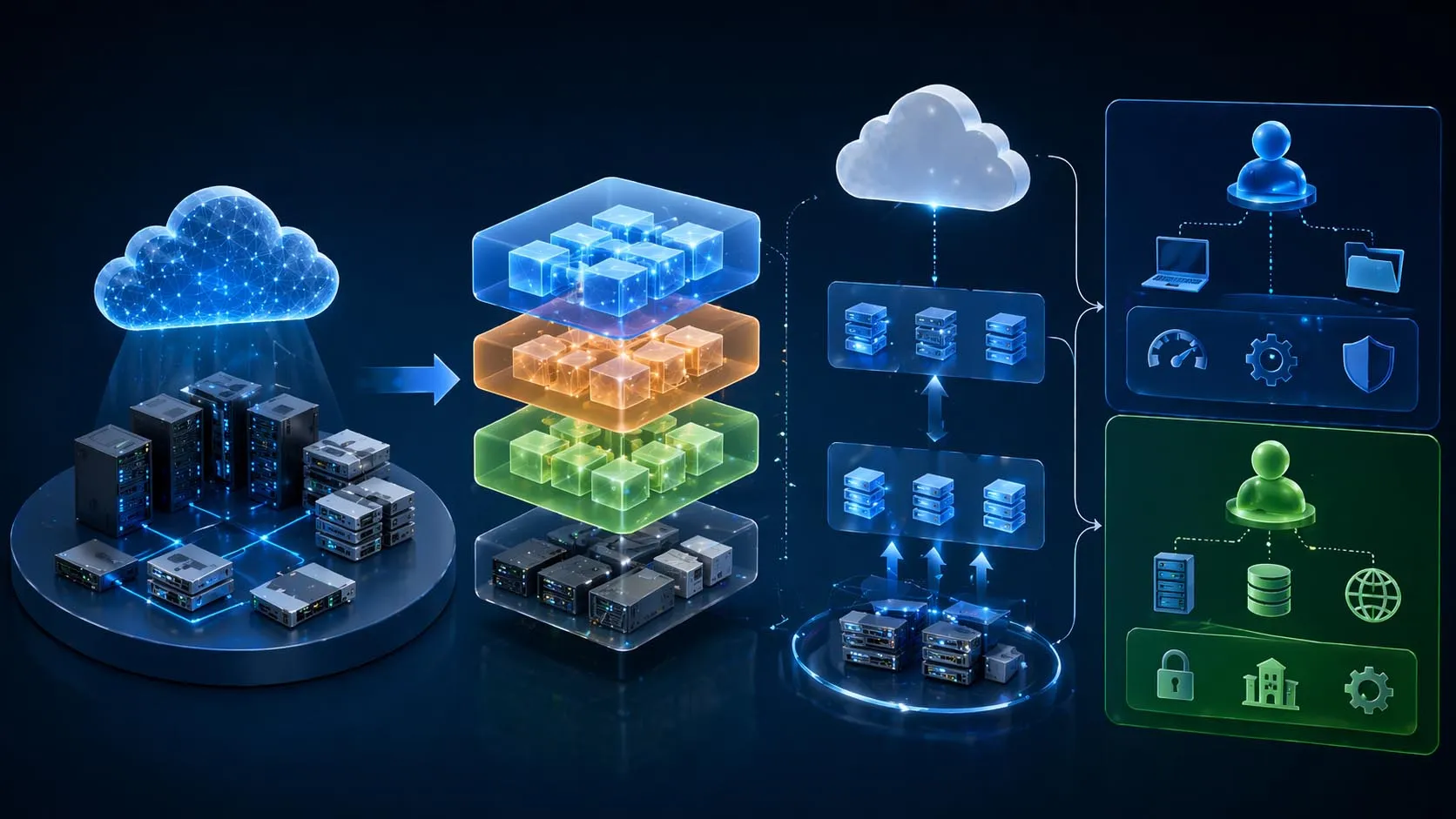
Cloud services work by abstracting infrastructure into provider-managed service layers that customers can deploy and scale on demand.
Main Types of Cloud Services
Infrastructure Services
Infrastructure-oriented cloud services provide core resources such as compute, storage, networking, and virtual machine capacity. These services are often used when organizations want flexibility at the system level while avoiding the cost and complexity of operating all physical infrastructure on their own. They are common in server migration, disaster recovery, development environments, branch connectivity, and application hosting projects.
Infrastructure services appeal to teams that still need architectural control but want to consume that control through a more agile and scalable service model. They can support both traditional enterprise applications and modern distributed workloads.
Platform Services
Platform-oriented cloud services provide environments for building, testing, deploying, and running applications without requiring teams to manage every infrastructure detail directly. These services may include runtime frameworks, container platforms, databases, integration tools, development services, analytics engines, and application middleware.
For many organizations, platform services speed up innovation because they reduce operational burden and allow development teams to focus more on application logic, service delivery, and user value. This makes them especially attractive for digital services, internal business systems, customer portals, and data-driven applications.
Software Services
Software-oriented cloud services deliver finished applications that users access through browsers, clients, or managed interfaces. Examples include email platforms, collaboration suites, CRM systems, ERP platforms, document management tools, video conferencing, customer support systems, and many specialized industry applications.
This model is often the easiest entry point for cloud adoption because the organization consumes a ready-to-use service rather than building the full application environment itself. It can improve deployment speed, reduce maintenance overhead, and standardize user access across different departments and locations.
Key Benefits of Cloud Services
Scalability and Flexibility
One of the most widely recognized benefits of cloud services is scalability. Organizations can grow capacity more easily as business demand increases and avoid overbuilding infrastructure for hypothetical future needs. This is valuable for expanding companies, digital platforms, customer-facing applications, and services with changing usage patterns.
Flexibility is just as important. Cloud services allow teams to launch new environments, test ideas, support remote operations, and adapt to changing priorities with less friction than many traditional models. This helps IT become a more responsive business enabler rather than a long-cycle support function.
Faster Deployment and Innovation
Cloud services can shorten the time required to deploy infrastructure, launch applications, and enable new services. Instead of waiting for procurement, rack installation, and manual configuration at every stage, organizations can often activate resources rapidly and standardize the way environments are built.
This accelerates experimentation and delivery. Development teams can prototype more quickly, business units can adopt tools sooner, and organizations can respond to new customer, market, or operational requirements without waiting for long infrastructure build cycles. In competitive sectors, that speed can create meaningful business advantage.
Operational Efficiency
Cloud services can also improve operational efficiency by reducing the day-to-day burden of maintaining physical infrastructure, managing routine platform tasks, and supporting distributed availability manually at every site. This does not eliminate IT work, but it allows more effort to be directed toward architecture, optimization, security, automation, and business-facing service improvement.
For organizations with limited technical teams, this shift can be especially valuable. Instead of spreading staff too thin across hardware maintenance, patching, backups, and capacity firefighting, teams can use more of their time on higher-value operational priorities.
Resilience and Business Continuity
Many cloud services support stronger resilience through geographic distribution, backup options, redundant architectures, and faster recovery models. If designed properly, cloud-based services can help organizations reduce downtime risk and improve continuity across sites, users, and applications.
This is particularly important for modern businesses that support remote workers, multi-location operations, customer-facing digital services, or industrial monitoring environments where availability matters. Cloud services do not guarantee resilience automatically, but they provide building blocks that make resilient design more achievable.
The real business value of cloud services is not only lower infrastructure friction. It is the ability to align technology capacity, speed, and resilience more closely with actual business priorities.
The Business Value of Cloud Services
Better Alignment Between IT and Business Demand
One of the strongest reasons organizations adopt cloud services is that the cloud allows technology to follow business demand more closely. When a new office opens, a project expands, an online service grows, or a temporary workload appears, the organization can respond more quickly with service-based infrastructure and applications.
This alignment improves planning and reduces the gap between strategic intent and technical execution. IT becomes better positioned to support expansion, innovation, service delivery, and operational responsiveness across the business.
Support for Digital Transformation
Cloud services are also a major enabler of digital transformation. They support modern application development, analytics, centralized data access, mobile workflows, remote collaboration, and platform integration. As organizations digitize more of their processes, cloud services make it easier to connect users, data, and applications across locations and departments.
For many enterprises, cloud adoption is not a single migration event but an ongoing modernization path. Different systems move at different speeds, and cloud services provide flexible models for hosting, integration, communication, security, and business continuity during that journey.
Improved Access Across Distributed Operations
Cloud services are especially valuable for distributed organizations. Businesses with branch offices, mobile teams, field personnel, remote workers, or multiple facilities often need centralized access to applications, communications, data, and management tools. Cloud-based delivery simplifies that access model by reducing dependence on a single local site.
In practice, this can improve user consistency, service reach, and management efficiency across geographically separated operations. It also supports business continuity when local infrastructure is limited or when access patterns change unexpectedly.
Common Applications of Cloud Services
Enterprise Applications and Collaboration
Many organizations use cloud services for email, messaging, document sharing, customer relationship management, enterprise resource planning, video meetings, workflow automation, and collaboration platforms. These services help users work across departments and locations without relying entirely on locally hosted applications.
This application model is especially useful when organizations want standardized access, easier updates, and broader support for remote or hybrid work patterns. It also helps simplify user onboarding and improve service consistency across multiple sites.
Application Hosting and Development
Cloud services are widely used to host websites, portals, mobile back ends, API services, internal applications, and development pipelines. They give teams the ability to launch environments faster, scale them more easily, and integrate them with analytics, security, database, and automation services.
For software teams, this creates a more agile delivery model. For business teams, it means digital services can be deployed and improved with less dependency on long infrastructure cycles.
Backup, Disaster Recovery, and Data Protection
Another major application is backup and recovery. Cloud services can support off-site data protection, archive retention, disaster recovery environments, and restoration workflows. This is valuable for organizations that want stronger protection against hardware failure, site disruption, ransomware impact, or operational outages.
Because the cloud can support remote and geographically separated storage, it often strengthens continuity planning when combined with sound recovery design and policy control.
Industrial, IoT, and Multi-Site Operations
Cloud services are increasingly used in industrial and distributed operating environments to centralize monitoring, aggregate field data, support dashboards, manage alerts, connect remote assets, and enable cross-site coordination. Utilities, transport networks, campuses, manufacturing sites, communication platforms, and service providers often benefit from cloud-based visibility and centralized management.
In these cases, cloud services help unify dispersed systems into a more manageable architecture. They can support analytics, remote operations, reporting, maintenance insight, and service continuity across sites that would otherwise be difficult to coordinate through local-only infrastructure.
Important Considerations Before Adopting Cloud Services
Security, Governance, and Responsibility
Cloud services offer many advantages, but they also require clear governance. Organizations still need to manage identity, access control, encryption, backup policy, regulatory obligations, monitoring, and configuration discipline. A cloud service can be technically strong and still be used poorly if governance is weak.
This is why successful adoption depends on understanding the shared responsibility model. The provider may secure the underlying platform, but the customer still has to secure how the service is used inside the business environment.
Integration and Architecture Planning
Cloud services work best when they are part of a coherent architecture rather than a collection of disconnected subscriptions. Applications, data flows, user access patterns, on-premises systems, network design, and compliance requirements all need to be considered together. Good planning prevents fragmented operations and reduces future migration difficulty.
For many organizations, the right answer is not all-cloud or all-local. It is a hybrid approach that places different services in the environments where they create the most value.
Cost Visibility and Operational Control
Cloud services can improve financial flexibility, but they still require active cost management. On-demand consumption is powerful, yet costs can rise quickly if services are oversized, left running unnecessarily, or deployed without governance. Mature organizations therefore combine cloud agility with monitoring, tagging, budgeting, and lifecycle control.
The goal is not just to move workloads to the cloud. It is to operate them in a way that preserves performance, security, and value over time.
Cloud services deliver their best results when flexibility is matched with architecture discipline, security accountability, and ongoing operational governance.
FAQ
What are cloud services in simple terms?
Cloud services are computing, storage, software, and digital capabilities delivered over the internet or a network on demand, rather than being built and managed entirely on local infrastructure.
Are cloud services only for large enterprises?
No. Small businesses, mid-sized organizations, public institutions, and large enterprises all use cloud services. The value depends on the workload, business goals, and operational model rather than company size alone.
What is the difference between cloud services and traditional IT?
Traditional IT often relies more heavily on locally owned and maintained infrastructure, while cloud services provide technology as a service through provider-managed environments with more flexible provisioning and scaling.
What are the main benefits of cloud services?
The main benefits typically include scalability, flexibility, faster deployment, better support for distributed operations, improved resilience options, and closer alignment between technology use and business demand.
Can cloud services work with on-premises systems?
Yes. Many organizations use hybrid architectures in which cloud services work alongside local infrastructure, existing applications, industrial systems, and private network environments.