A proxy server is an intermediary system that receives a request from one party, processes or forwards that request, and then relays the response back to the requester. In networking terms, it sits between a client and a destination service rather than allowing the client to communicate with that destination directly. This intermediary role can be used for many purposes, including access control, security filtering, privacy, caching, protocol handling, content optimization, and traffic management.
Proxy servers have been part of network and application design for many years, but the term covers several different architectures. In some cases, the proxy represents the client side of the connection and is used to regulate outbound access to the internet or to external resources. In other cases, the proxy represents the server side and stands in front of applications or websites to protect them, accelerate them, or distribute traffic more effectively. Because of that, understanding proxy servers requires more than a simple definition. It requires knowing which side the proxy represents and what function it is meant to perform.
In modern IT environments, proxy servers remain highly relevant across enterprise security, cloud application delivery, web performance, remote access, development workflows, and multi-site operations. They are used in corporate networks, content delivery paths, application publishing, API traffic handling, identity-aware access control, and many other environments where direct client-to-server communication is either not ideal or should be controlled more carefully.

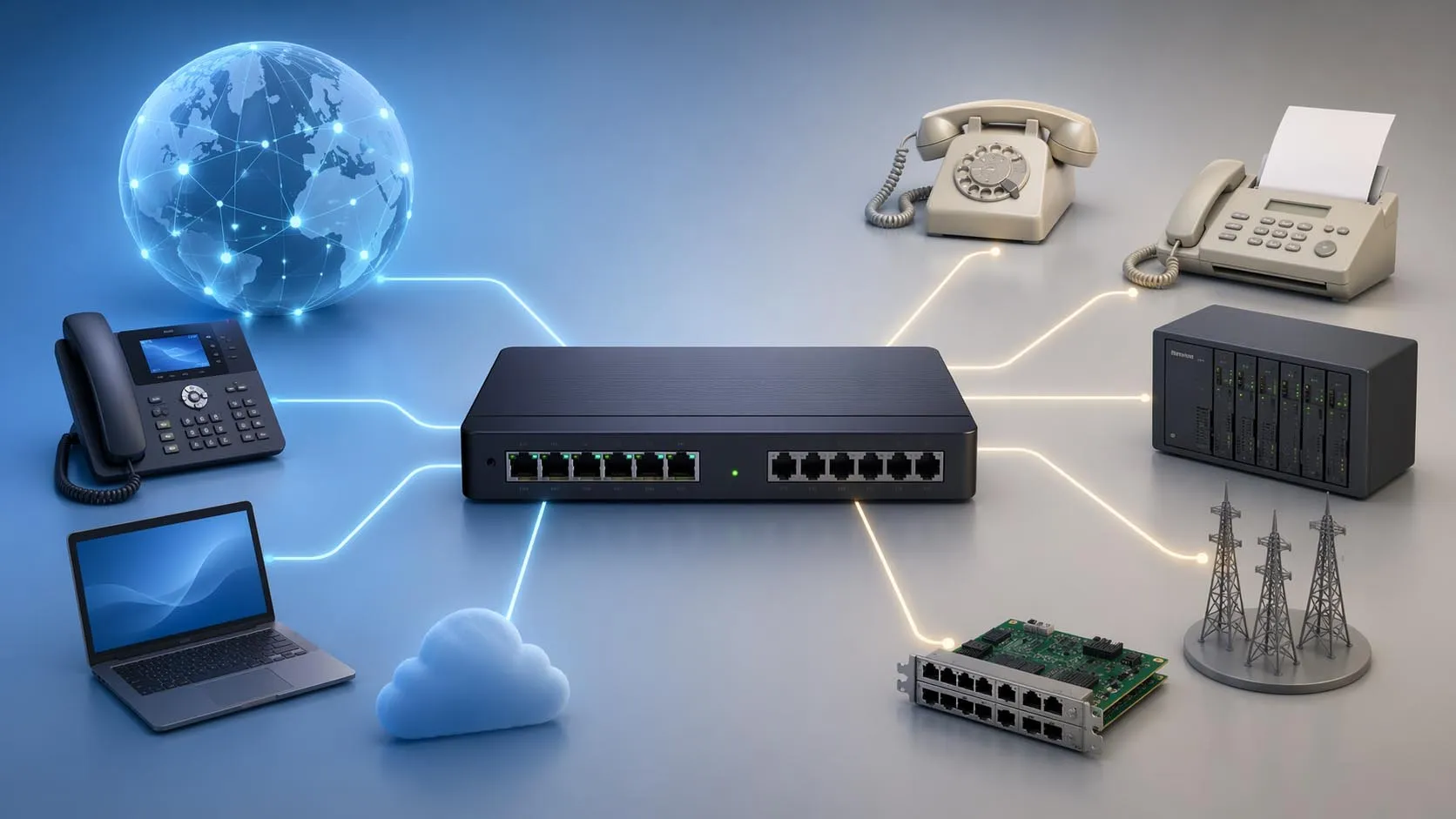
A proxy server sits between communicating endpoints and can forward, filter, cache, secure, or optimize traffic depending on its role.
What a Proxy Server Means in Networking
An Intermediary Between Two Network Parties
At the most basic level, a proxy server is a system that handles traffic on behalf of another endpoint. A client sends a request to the proxy, the proxy processes or forwards that request to the next destination, and the resulting response is returned through the proxy. The important point is that the original requester does not communicate directly with the final service in the usual end-to-end way. The proxy becomes part of the communication path.
This intermediary design creates opportunities for control and optimization. Because the proxy sees the request before it reaches the destination, it can enforce policies, inspect traffic, authenticate users, hide network details, cache content, or route traffic through a particular path. The proxy can also modify headers, terminate connections, or add metadata needed by downstream systems.
This is why proxy servers are widely used not only for web browsing but also for application delivery, API mediation, secure access, and service publishing. The concept is broad because the proxy role is broad.
Forward Proxy vs Reverse Proxy
One of the most important distinctions is the difference between a forward proxy and a reverse proxy. A forward proxy acts on behalf of the client side. It is typically used by internal users or devices when reaching external resources, such as websites, SaaS platforms, or other internet services. It helps control outbound access and can hide or mediate the client’s identity from the destination side.
A reverse proxy acts on behalf of the server side. It sits in front of one or more origin servers or applications and receives client requests before passing them to the appropriate backend service. In this role, the client sees the reverse proxy as the public-facing endpoint, while the origin infrastructure remains behind it.
This distinction matters because the same word, proxy, is often used to describe both patterns. The two are related, but they solve different problems. Forward proxies focus more on client-side policy, privacy, and outbound mediation. Reverse proxies focus more on application exposure, security, scalability, caching, and traffic distribution.
A proxy server is not defined only by the fact that it forwards traffic. It is defined by which side it represents and what control or service function it adds to the communication path.
How a Proxy Server Works
Request Reception and Forwarding
The operating flow of a proxy server usually begins when a client directs traffic to the proxy instead of to the final destination. The proxy receives the request, interprets it according to its configuration and protocol logic, and then decides what to do next. It may forward the request as-is, reject it, rewrite part of it, inspect it for compliance or risk, or serve a stored response from cache.
If the request is allowed and must be forwarded onward, the proxy establishes or uses a connection to the next hop or target service. When the destination responds, the proxy receives that response and relays it back to the original requester. Depending on the implementation, it may also modify headers, log metadata, enforce content policy, or apply compression or caching behavior before returning the response.
This makes the proxy both a traffic intermediary and a control point. It does not simply move packets along. It often participates actively in how the communication is managed.
Connection Handling, Inspection, and Policy
Because the proxy sits in the middle of the request path, it can apply rules before traffic continues. In enterprise environments, that may mean authenticating users, filtering URLs, blocking categories of traffic, scanning requests, or enforcing data-loss-prevention policies. In reverse proxy environments, it may mean checking security rules, offloading TLS, rate limiting requests, or routing them to specific application pools.
The degree of visibility depends on the protocol and how the proxy is deployed. Some proxies handle only specific application protocols such as HTTP, HTTPS, or SOCKS-based traffic. Others operate in transparent or tunneling modes. Some can inspect content deeply, while others primarily forward and mediate the connection path without understanding every application detail.
This is why proxy design must match the intended use case. A proxy meant for web filtering is not identical to one meant for load balancing or application publishing.
Headers, Client Identity, and the Original Source
One operational detail that often appears in proxy environments is client identity preservation. When a proxy forwards traffic, the destination may see the proxy’s address rather than the original client address unless the system uses additional metadata or forwarding conventions. In HTTP environments, standardized or de facto forwarding headers are often used so downstream services can understand the earlier path or recover relevant request information.
This is especially important with reverse proxies, content delivery paths, and load balancers. Applications often need to know the original client IP, protocol, or host context for logging, policy, analytics, or access decisions. Proxy-aware application configuration therefore becomes part of correct deployment.
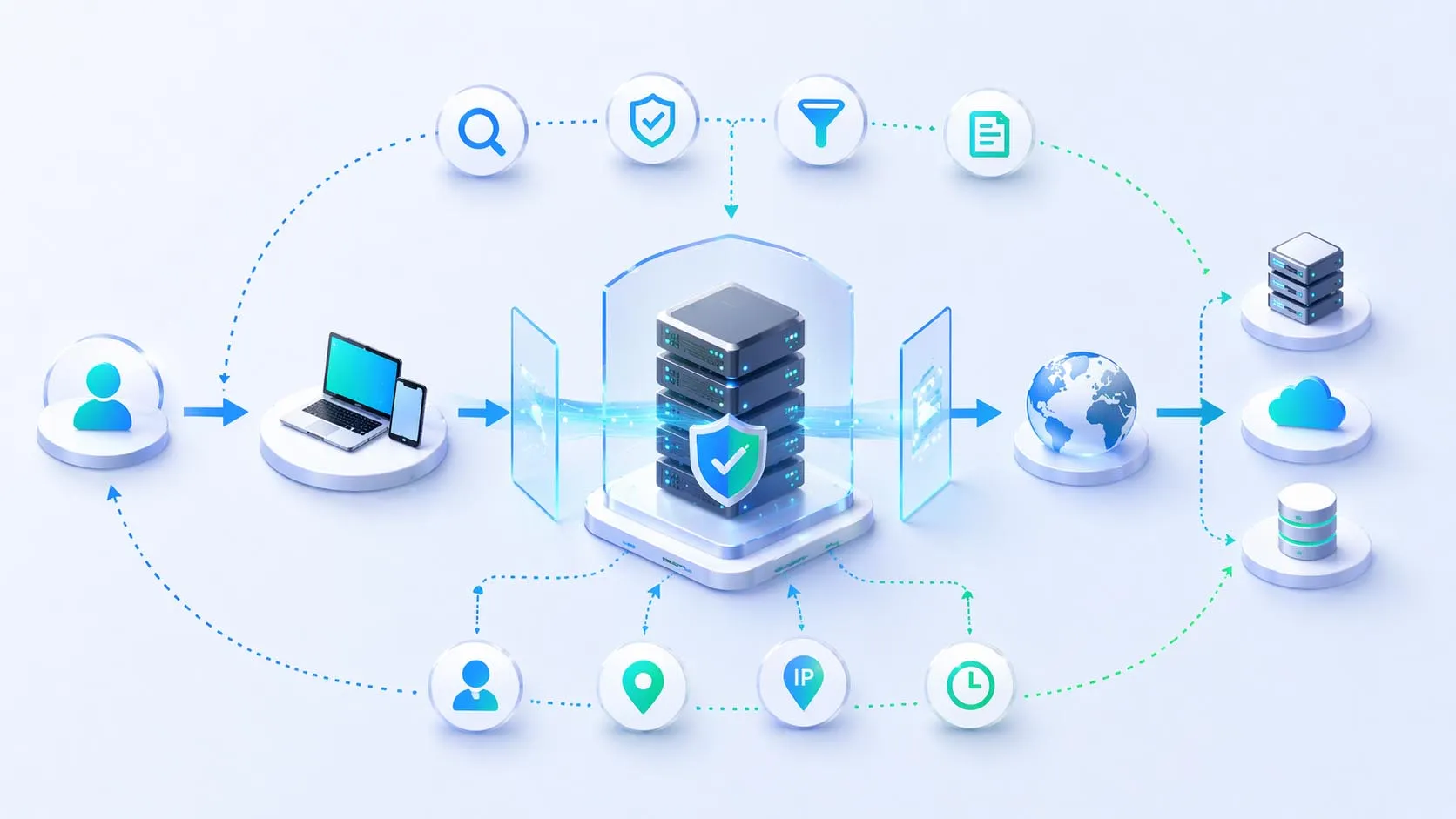
Proxy servers work by receiving requests first, applying rules or services, and then forwarding or relaying traffic as needed.
Common Types of Proxy Servers
Forward Proxy
A forward proxy is most often used on the client side of a network. Users or devices send traffic to the proxy when accessing the internet or external resources. The proxy can apply authentication, logging, content filtering, access restrictions, and outbound policy enforcement before the request leaves the organization.
This model is common in corporate networks, education environments, and security-focused deployments where internet access must be controlled or monitored. It can also be used to centralize egress policy and hide internal addressing details from external sites.
Reverse Proxy
A reverse proxy sits in front of servers or web applications and accepts client requests on their behalf. It then forwards those requests to one or more backend services based on rules such as hostname, path, health status, load distribution, or service type. Reverse proxies are common in modern web application architecture because they simplify exposure of internal services and create a strong control point for security and performance.
They are frequently used for TLS termination, caching, compression, rate limiting, header management, authentication integration, and backend routing. Reverse proxies are also closely associated with CDNs, load balancers, and application gateways.
Transparent Proxy
A transparent proxy intercepts traffic without requiring the client to be explicitly configured to use it. It is often deployed in managed networks where administrators want to apply policy, filtering, or caching at the network layer. The client may not be fully aware that a proxy is handling the request path.
Transparent proxies can be useful for centralized control, but they also require careful design because application behavior, privacy expectations, and protocol compatibility may be affected if interception is not handled properly.
SOCKS Proxy
A SOCKS proxy is a more general-purpose proxy model that forwards traffic at a lower level than a typical HTTP proxy. It does not focus only on web semantics and can be used for a wider range of protocols and applications. Because of this, SOCKS proxies are often used in testing, tunneling, specialized network access scenarios, and applications that need broader traffic relay support.
However, a SOCKS proxy does not inherently provide the same application-aware features as an HTTP reverse proxy or a security web gateway. It is flexible, but the deployment goals should be clear.
Main Uses of Proxy Servers
Access Control and Content Filtering
One of the most common uses of a proxy server is controlling outbound access. Organizations often use forward proxies to define which sites, services, or content categories users may reach. This helps enforce acceptable-use policy, reduce exposure to risky destinations, and create a log trail for internet access activity.
Content filtering can also support regulatory or organizational requirements. Schools, enterprises, and public institutions frequently use proxy-based controls to limit specific traffic categories and to apply identity-based browsing rules.
Privacy, Address Mediation, and Egress Control
Proxy servers can also mediate the identity or address information visible to the next system in the path. In a forward-proxy model, the destination commonly interacts with the proxy rather than with the internal client directly. This can help centralize outbound presence, simplify egress rules, and hide private internal addressing from the external side.
That does not automatically mean complete anonymity, but it does mean the proxy becomes the visible intermediary for part of the communication path. In enterprise design, this is often more about policy and architecture than about anonymity alone.
Caching and Performance Optimization
Another important use of proxy servers is caching. If a proxy stores reusable responses, later requests for the same resource may be served more quickly without contacting the origin every time. This can reduce latency, lower bandwidth consumption, and improve user experience for frequently requested content.
Caching is especially associated with reverse proxies, CDNs, and some managed access environments. When the same static or semi-static resources are requested repeatedly, proxy-based caching can provide measurable efficiency benefits.
Application Protection and Traffic Distribution
Reverse proxies are widely used to protect and distribute access to applications. They can shield origin servers from direct exposure, enforce TLS and header policy, perform health-aware routing, and distribute requests across multiple backend instances. In this role, the proxy becomes part of the application delivery and resilience strategy.
This use case is central in modern web hosting, API publishing, SaaS platforms, cloud-native services, and multi-server deployments where security and scale must be managed together.
The value of a proxy server is rarely just that it sits in the middle. Its value comes from what it can enforce, optimize, hide, accelerate, or protect while it sits in the middle.
Benefits of Using a Proxy Server
Improved Security Control
Proxy servers create an additional control layer between clients and target services or between clients and origin applications. This makes them useful for blocking unwanted traffic, reducing direct exposure of internal systems, applying authentication, and enforcing policy before requests reach sensitive resources.
In server-side deployments, reverse proxies can also reduce the attack surface seen by the public internet by sitting in front of origin infrastructure and handling security-related policy at the edge.
Better Visibility and Governance
Because proxies handle traffic centrally, they can provide logging, request history, policy enforcement, and operational visibility. This helps administrators understand how resources are being accessed and can support troubleshooting, governance, and compliance review.
Centralized visibility is especially valuable in larger environments where many users, devices, or applications need to follow a consistent access and control model.
Higher Performance and Efficiency
When caching, compression, connection reuse, or traffic distribution are configured well, proxy servers can improve performance and reduce backend load. They can also help scale application delivery by distributing requests across multiple servers or by serving some content directly from an intermediary layer.
This is one reason reverse proxies are so common in web architecture. They add a useful optimization point between users and origin systems.
More Flexible Architecture
Proxy servers also help organizations build more flexible architectures. They make it easier to insert policy, identity, security, optimization, and routing behavior into communication paths without redesigning every client or application directly. This can simplify migration, hybrid deployments, API exposure, and controlled internet access strategies.
As environments grow more distributed, this architectural flexibility becomes even more valuable.

Proxy servers are used across browsing control, application publishing, caching, security enforcement, and traffic optimization scenarios.
Common Applications of Proxy Servers
Enterprise Internet Access
Many organizations deploy forward proxies or secure web gateway functions to manage employee access to the internet. This can include URL filtering, identity-based policy, malware screening, logging, and controlled outbound routing. In this application, the proxy is part of the enterprise security boundary.
This is common in offices, schools, public institutions, and regulated environments where outbound web access must follow central rules.
Web Application Delivery
Reverse proxies are widely used in front of websites, APIs, and internal applications that need controlled exposure. They can terminate TLS, route traffic to different backend services, cache content, and enforce application-layer security policy. In cloud and hybrid architectures, this is one of the most visible and important proxy use cases.
It is especially useful when multiple application services sit behind a single public entry point.
Content Delivery and Caching
Proxy behavior is also central to content delivery design. Reverse proxy layers and CDN-like services can store frequently requested content closer to users and reduce repetitive load on origin servers. This improves responsiveness and helps websites or services scale more smoothly under repeated demand.
For static assets, public web content, and distributed applications, this is often a major performance benefit.
Remote Access, Testing, and Specialized Routing
Some proxy models are used in development, testing, traffic debugging, tunneling, or specialized routing environments. Developers may place a proxy in the path to inspect requests, simulate conditions, or mediate access to target services. SOCKS and other general-purpose proxy models are common in these scenarios.
In network and security operations, proxies may also be used to centralize access to specific services or to route traffic through controlled paths for visibility and policy reasons.
Cloud and Multi-Site Environments
In distributed environments, proxies can help unify access control, secure application publishing, and maintain consistent request handling across branch sites, cloud services, and hybrid infrastructure. Reverse proxies can front applications regardless of where the backend runs, while forward-proxy or secure-access models can help enforce policy for users across different locations.
This makes proxy servers highly relevant in modern architectures that span on-premises systems, cloud platforms, and remote users.
Important Deployment Considerations
Choose the Right Proxy Model
The first design question is whether the environment needs a forward proxy, a reverse proxy, a transparent proxy, or a more specialized model. Using the wrong type can create confusion and operational gaps. A team trying to protect web applications needs a different proxy role than a team trying to control employee web access.
Clear role definition prevents architecture drift and helps ensure the proxy is evaluated against the correct requirements.
Account for Headers, Logging, and Trust Boundaries
Proxy deployments often alter what downstream services see about the original request path. Administrators should plan carefully for client IP preservation, forwarded metadata, trusted headers, and application awareness of upstream proxies. Logging and monitoring should also reflect the proxy layer so that request paths can be understood accurately.
This is especially important when multiple proxies or delivery layers sit in the same path.
Balance Control with Compatibility
Proxy servers can add strong policy and visibility, but they can also introduce compatibility issues if deployed carelessly. TLS interception, transparent handling, caching rules, and protocol-specific behaviors should be evaluated against application needs. Some traffic types are proxy-friendly, while others require more careful treatment.
Successful deployments therefore combine policy goals with realistic application testing.
The best proxy design is not the one that adds the most control everywhere. It is the one that adds the right control, at the right layer, without breaking the communication it is meant to support.
FAQ
What is a proxy server in simple terms?
A proxy server is an intermediary system that receives requests from a client, forwards or processes them, and then returns the response instead of letting the client communicate directly with the destination.
What is the difference between a forward proxy and a reverse proxy?
A forward proxy represents the client side and is commonly used for outbound access control, while a reverse proxy represents the server side and is commonly used in front of applications or websites.
What are proxy servers used for?
They are used for access control, security filtering, privacy and address mediation, caching, performance optimization, application protection, traffic routing, and centralized policy enforcement.
Is a proxy server the same as a VPN?
No. Both can intermediate traffic, but they serve different architectural purposes and operate differently. A proxy usually handles specific traffic paths or application-layer requests, while a VPN typically creates a broader encrypted tunnel for network traffic.
Where are proxy servers commonly used?
They are commonly used in enterprise networks, web application delivery, CDNs, cloud and hybrid environments, secure internet access deployments, development and testing workflows, and multi-site IT architectures.